
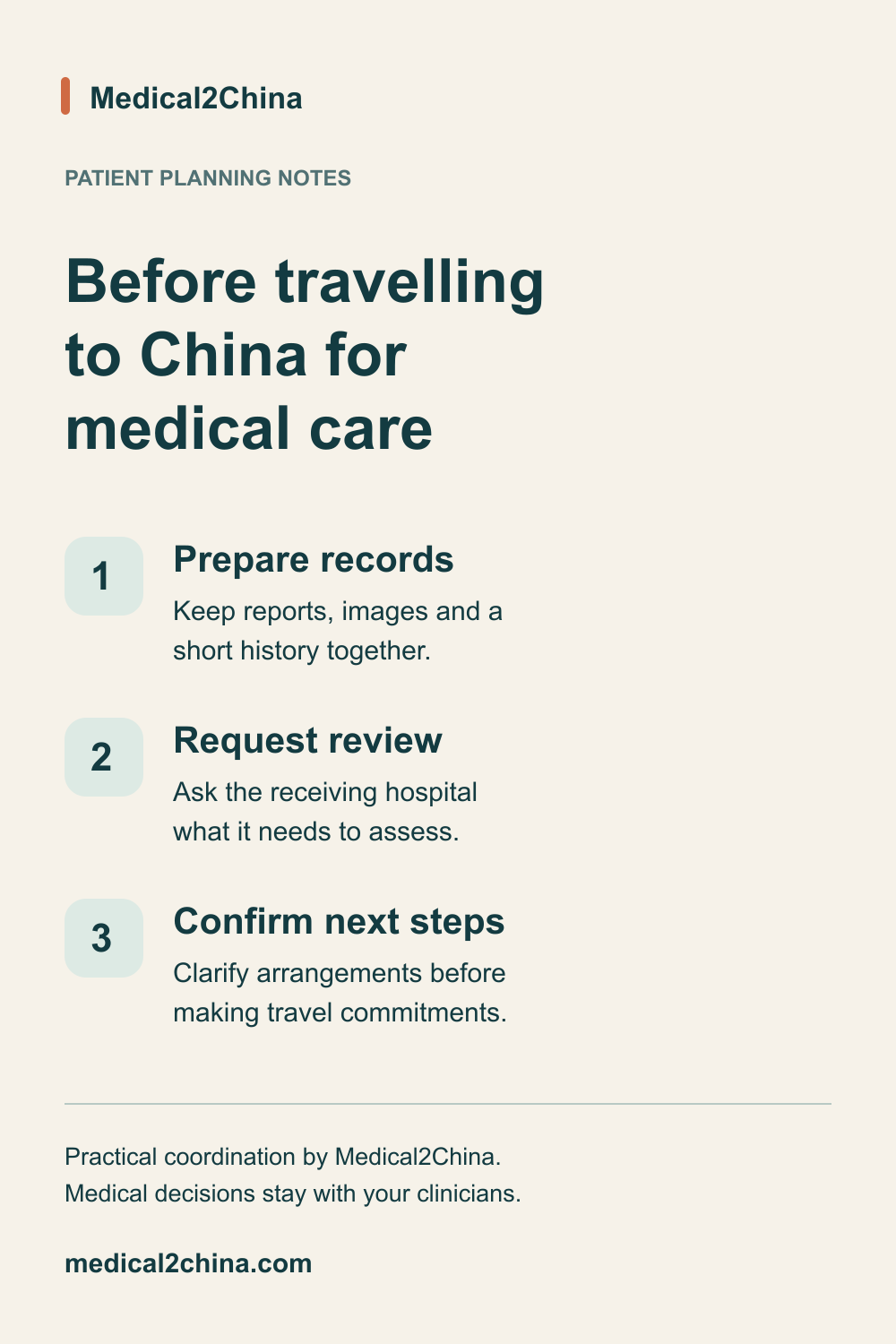
Medical2China helps patients, families and prospective partners coordinate practical steps for assessment and care in China. A qualified clinical team makes medical decisions. Use this guide to prepare a useful first exchange with the receiving team.
Start with the question
Write a short description of what you want assessed: an existing diagnosis, treatment options, or the need for further assessment. Keep the patient's priorities visible. A focused question helps organise the records around a purpose.
Keep the records readable
Prepare a dated summary of relevant diagnoses, procedures and treatment, the requested reports, a current medication list and allergy information. Ask the receiving hospital what original imaging or pathology material it needs, in which formats and languages, and how to submit it. Keep originals with translations. Confirm who is authorised to share information and receive replies. Please do not post identifiable medical records in public comments.
Ask what has actually been confirmed
Receiving documents, reviewing a case, arranging an appointment and accepting a patient for admission or treatment are different stages. Ask which team reviewed the case, what is missing, the nature of its response and who will confirm the next step. A review may lead to more questions or an in-person assessment; it does not guarantee a particular treatment.
Before making travel commitments
Request written details of the hospital, department and campus; the proposed next step; any missing documents; estimated fees and exclusions; confirmed language support; and a contact for changes. Discuss medical suitability for travel with the treating clinician and confirm separate carrier requirements where applicable. Do not infer clinical suitability from an available appointment.
For referring organisations and service partners
Include the patient's permission, the precise clinical question, an indexed document list and the named handover contact. State the decision being requested and who will confirm it. A referral does not itself confirm hospital acceptance, insurance payment or treatment. Service scope and financial responsibilities need agreement between the actual parties. Ask how records and follow-up information will return to the patient's responsible clinicians after the visit.
Listen: Before You Travel
This company-published episode uses synthetic narration and provides general planning information. It does not portray a doctor or a patient interview. The complete transcript appears below.
Audio in English. The transcript follows your selected page language.
Download the English audio · Read the original English transcript
Full transcript
Welcome to Before You Travel, practical planning notes from Medical2China. This episode uses a synthetic voice to read our company prepared information. It is a guide to organising a planned hospital assessment, not a medical consultation.
If someone in your family is considering care in China, the first useful step is often a clear question, rather than a flight booking. Are you asking for a review of an existing diagnosis, another opinion on treatment options, or an appointment for further assessment? Write that question in one or two sentences. Keep the patient's own priorities in view.
Next, organise the information that helps a receiving team understand the case. Start with a short timeline of important diagnoses, procedures and treatments. Gather relevant reports, a current medication list and information about allergies. Ask the receiving hospital which original imaging files or pathology materials it needs. A photograph of a report may not replace the underlying material. Requirements differ, so get the requested list before paying for translations or sending physical items.
Keep original documents alongside any translations. Mark dates clearly, and identify which report belongs to which examination. If relatives are helping, agree who is authorised to share information and who will receive replies. Avoid putting identifiable medical records in public comments or social media messages. Ask for the designated submission route.
Then separate the stages of the process. A team agreeing to receive documents is not the same as completing a medical review. A review is not the same as offering a hospital appointment. An appointment is not confirmation of admission, surgery or a particular treatment. Ask what has been confirmed, what remains undecided, and who will make the next decision.
Before making travel commitments, request a written summary of the practical arrangements. Which hospital, department and campus are involved? Is the proposed next step remote review or an in person visit? What documents are missing? What fees are estimates, and what is included or excluded? What language support has actually been arranged? Who should the family contact if the timetable or the patient's condition changes?
The clinical team must decide whether an assessment or treatment is appropriate. Travel arrangements also need their own checks. Discuss medical fitness for travel with the treating clinician, and confirm any airline requirements separately. Do not change ongoing treatment while waiting for a reply without speaking to the responsible clinician.
For an agency or referring organisation, the same preparation should include a clear handover: the patient's permission, the clinical question, the documents supplied, the named contact and the next decision still required. Sending a referral does not itself establish insurance payment, hospital acceptance or an agreed treatment plan.
Medical2China helps patients, families and prospective partners coordinate the route to assessment and care in China. Clinical decisions remain with the qualified medical team. The goal of preparation is a more useful conversation and a clearer next step. Keep three things together: your question, your records and the written confirmation of what happens next.
Your next step
Read Medical2China's service information to understand our coordination role. Patients and families can use our contact page for a general enquiry; do not send medical records or identifying health information to Medical2China. Clinical records go directly to the receiving provider through its approved channel. Organisations can explore partnership enquiries.
Background reading
CDC Yellow Book: Medical Tourism discusses planning, records and continuity of care. This resource does not endorse Medical2China. Hospital requirements differ and should be checked with the receiving institution.
Published by Medical2China. General planning information; diagnosis and treatment require individual clinical assessment.